You've tried melatonin. You've tried the magnesium. You've read about sleep hygiene more times than you can count. And you're still lying there at midnight with a brain that refuses to switch off. It's no surprise that more people are turning to cannabis for sleep. A 2024 Harris Poll found that 16% of American adults now use it as a sleep aid. That puts cannabis ahead of both prescription sleep aids and alcohol. But here's the thing most people don't talk about: it works really well for some people, and it does very little for others. The difference almost always comes down to what they're using and how they're using it. This guide is for anyone curious, skeptical, or somewhere in between.
TL;DR
Most New Yorkers pick the wrong product. Cannabis works best for sleep as a designed evening ritual, not an afterthought — the right combination of cannabinoids, dose, and timing matters far more than the THC number on the label.
Using cannabis for sleep means choosing a product with the right combination of cannabinoids (most often THC, CBN, or both) and taking it at the right time to help your body wind down. It works best alongside good sleep habits, not as a replacement for them. The right product for you depends on your experience level, your body, and what's actually keeping you awake.
Does cannabis actually help with sleep?
The honest answer is it can, but it's not guaranteed, and it's not the same for everyone. Research suggests that products with a small to moderate amount of THC alongside a small amount of CBD could be helpful for sleep, particularly for those new to cannabis. THC appears to help people fall asleep faster and stay asleep. CBN, a lesser-known cannabinoid, has also shown early promise; a 2024 University of Sydney study published in Neuropsychopharmacology found the first objective evidence that CBN increases total sleep time and boosts both NREM and REM sleep.
There is one trade-off worth knowing upfront. THC appears to decrease REM sleep, which is the stage where dreams happen. For most people trying to get through a rough patch of insomnia, this is an acceptable trade. Getting six hours of real sleep beats staring at the ceiling. But it is worth knowing, especially if you plan to use cannabis every night long-term.
The part most people get wrong
The most common mistake isn't choosing cannabis. It's choosing the wrong product, taking too much, or taking it at the wrong time.
- Picking by THC percentage. The number on the label tells you how strong a product is. It does not tell you how it will make you feel. Two gummies with the same THC content can produce completely different experiences depending on the other cannabinoids and terpenes in the formula. Terpenes, the compounds that give cannabis its flavor and aroma, may play a significant role in its effects. Myrcene, found in many indica-leaning products, is associated with a settling, sedative feel. Limonene, found in more energizing products, can make you feel more alert. If you have ever taken a cannabis product at night and felt wired instead of sleepy, a stimulating terpene profile is likely why.
- Taking an edible too late and then redosing. If taking edibles, consume a few hours before bedtime, ideally on an empty stomach before dinner. Most people take them an hour before bed, feel nothing at the 45-minute mark, and take another. The second dose arrives exactly when the first one peaks. That is how a 5mg experience becomes a 10mg or 20mg experience, which is not where you want to be at midnight.
- Expecting it to work without anything else changing. Cannabis is not a knockout pill. It works better when the room is cool, the phone is down, and the lights have been dim for a while. It amplifies the direction your body is already moving. If your body is still in "on" mode, cannabis can extend that feeling before the sedation kicks in.
What to look for in a cannabis sleep product
Products labeled as indica or indica-dominant hybrids may be a good starting point. You can also tell dispensary staff that you're looking for something with indica properties. The indica versus sativa distinction is not perfectly scientific, but it is still a useful shorthand when you are standing in a dispensary trying to make a decision. Beyond the label, here is what to look for:
- A THC+CBN combination. A 2025 meta-analysis in Sleep Medicine Reviews covering six randomized trials found that formulations combining THC and CBN improved subjective sleep quality significantly. CBD-only formulations did not show the same effect. This matters because CBD is heavily marketed for sleep, but the research currently points more strongly toward THC+CBN products. Brands like Camino and Off Hours, both available at New York dispensaries, make gummies with THC and CBN specifically formulated for nighttime use.
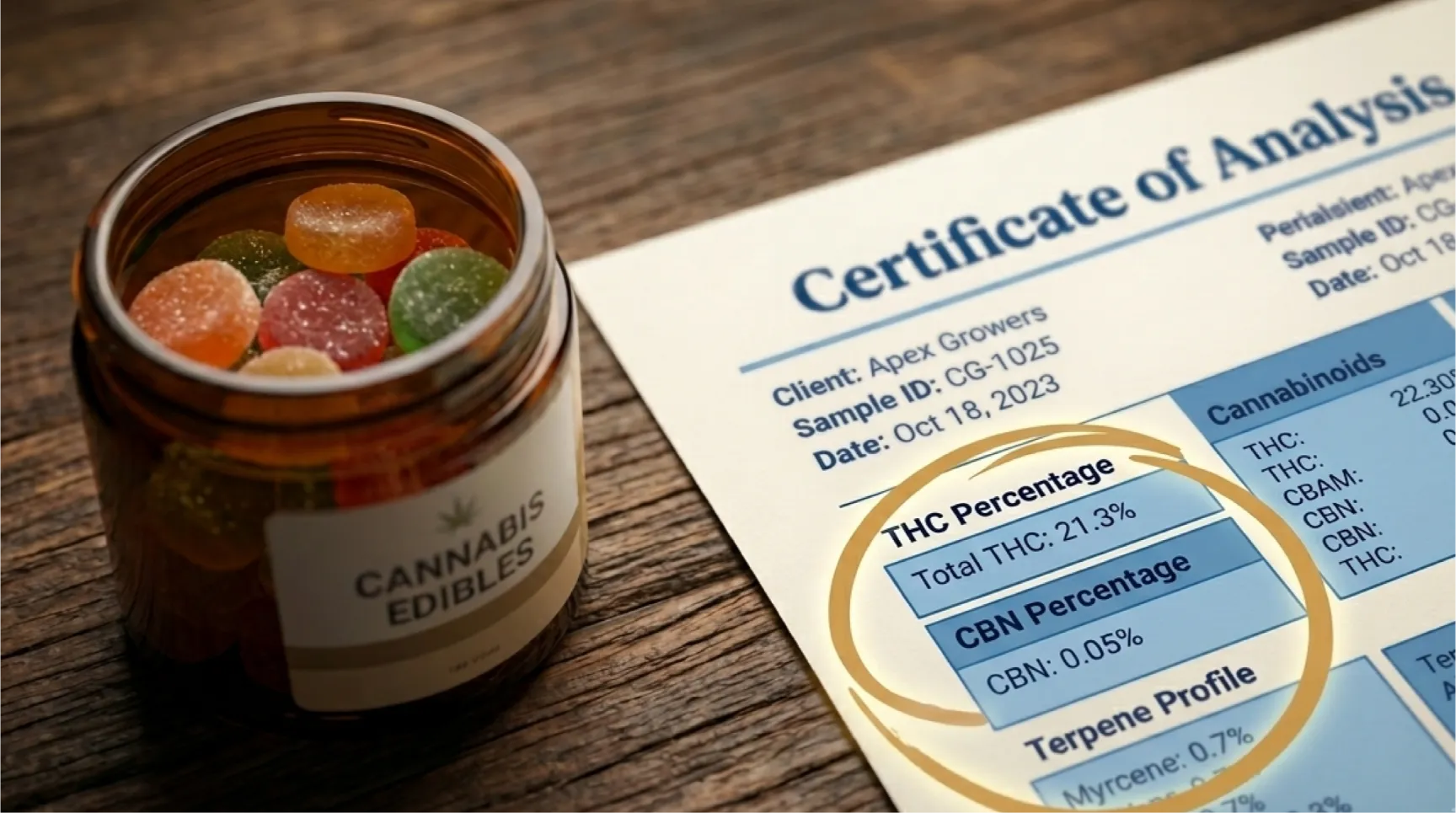
- A COA you can actually read. A Certificate of Analysis is the lab report for any cannabis product. It shows the exact cannabinoid and terpene content. Any licensed New York dispensary should have these on hand. If you see myrcene listed above 0.5% on the terpene section, that is a good sign for a sleep-focused product.
- A dose that starts low. If you are new to edibles, 2.5 to 5mg of THC is a sensible starting point. New York's per-serving limit is 10mg, but that is a ceiling, not a recommendation. Starting lower gives you more control and a better experience.
How to time it
This is probably the single most useful piece of practical information in this entire guide. Take it earlier than you think you need to. If you end up a bit sleepy before you planned to be, that is a much easier problem to have than taking it too late and lying awake waiting for it to work.
| Format | How long it takes to kick in | When to take it |
|---|---|---|
| Gummies / edibles | 45 to 90 minutes | 60 to 90 minutes before bed |
| Tincture (drops under the tongue) | 15 to 45 minutes | 30 to 45 minutes before bed |
| Vaporizer or flower | 5 to 15 minutes | About 15 minutes before bed |
A few things worth knowing
- Tolerance builds. If you use cannabis for sleep every night, you will likely need more over time to get the same effect. Some people use it for a period, then take breaks. Others find a dose that works and stick to it. There is no universal answer, but it is worth going in with eyes open.
- Stopping after regular use can disrupt sleep temporarily. Several long-term users report a few days of worse sleep after stopping, particularly vivid dreams as REM sleep rebounds. This typically passes within a week or two.
- It is not for everyone. Some people feel anxious or unsettled on cannabis, particularly at higher doses. If that has been your experience before, starting with a very low dose or a different cannabinoid ratio is worth trying before writing it off entirely.
None of these are reasons to avoid cannabis for sleep. They are reasons to approach it thoughtfully, which is what the right dispensary can help you do.
Conclusion
Cannabis for sleep works well for a lot of people. It does not work well for everyone. The gap between those two groups usually comes down to product selection, dose, and timing, not cannabis itself.
If you've been curious but haven't known where to start, or if you've tried it before and it didn't work the way you hoped, the answer is usually in the details. A slightly different formulation, a lower dose, or better timing can change the experience significantly.
The best next step is a conversation with someone who knows the products and can match what's on the shelf to what you're actually dealing with.
Please note
This content is for educational purposes only and does not constitute medical advice. Cannabis affects individuals differently. Must be 21+ to purchase in New York State. If you are experiencing persistent insomnia, consult a licensed healthcare provider.
FAQs
For gummies, 60 to 90 minutes. For tinctures, 30 to 45 minutes. For inhaled cannabis, about 15 minutes. When in doubt, go earlier.
The research currently supports a combination of both. THC helps you fall asleep faster. CBN appears to help you stay asleep longer. Combined formulations with both are available at licensed New York dispensaries.
Almost always a terpene issue. If the product contained high levels of limonene or pinene rather than myrcene, it may have felt stimulating. Try a myrcene-forward, indica-leaning product next time.
2.5 to 5mg THC for edibles if you are new or returning after a break. Give yourself a full two hours before you decide it is not working.
Regular use can lead to tolerance and some people find it hard to sleep without it after extended daily use. Using it a few nights a week rather than every night, and taking occasional breaks, helps avoid that pattern. If you are managing persistent insomnia, speaking with a doctor alongside trying cannabis is a sensible approach.
Visit JD's Jungle
Talk to one of our budtenders. Tell us what's keeping you up. We'll help you find a starting point that makes sense for you, not just what's selling.
Find a locationReferences
- Healthline — Best Cannabis for Sleep (Updated May 2026). https://www.healthline.com/health/best-strain-for-sleep
- University of Sydney / Neuropsychopharmacology (November 2024) — CBN and sleep architecture. https://www.nature.com/articles/s41386-024-02018-7
- Sleep Medicine Reviews meta-analysis (August 2025) — THC+CBN vs CBD-only formulations. https://www.sciencedirect.com/science/article/abs/pii/S1087079225001091
- New York State Cannabis Control Board Annual Report (2025). https://cannabis.ny.gov/system/files/documents/2025/12/ocm-annual-report_final-2025.pdf